Compare lift chairs for comfort and easier transitions
Power lift recliners use smooth electric motors to tilt upward and forward, assisting with standard sit-to-stand movements in the living room or bedroom. Learn what distinguishes different motor designs, frame sizes, and upholstery options before purchasing.
Compare 2-position, 3-position, and infinite-position dual-motor layouts.
Match seat depth, width, and user height to maintain posture while seated.
Review breathable weaves, wipe-clean synthetics, and stain-resistant finishes.
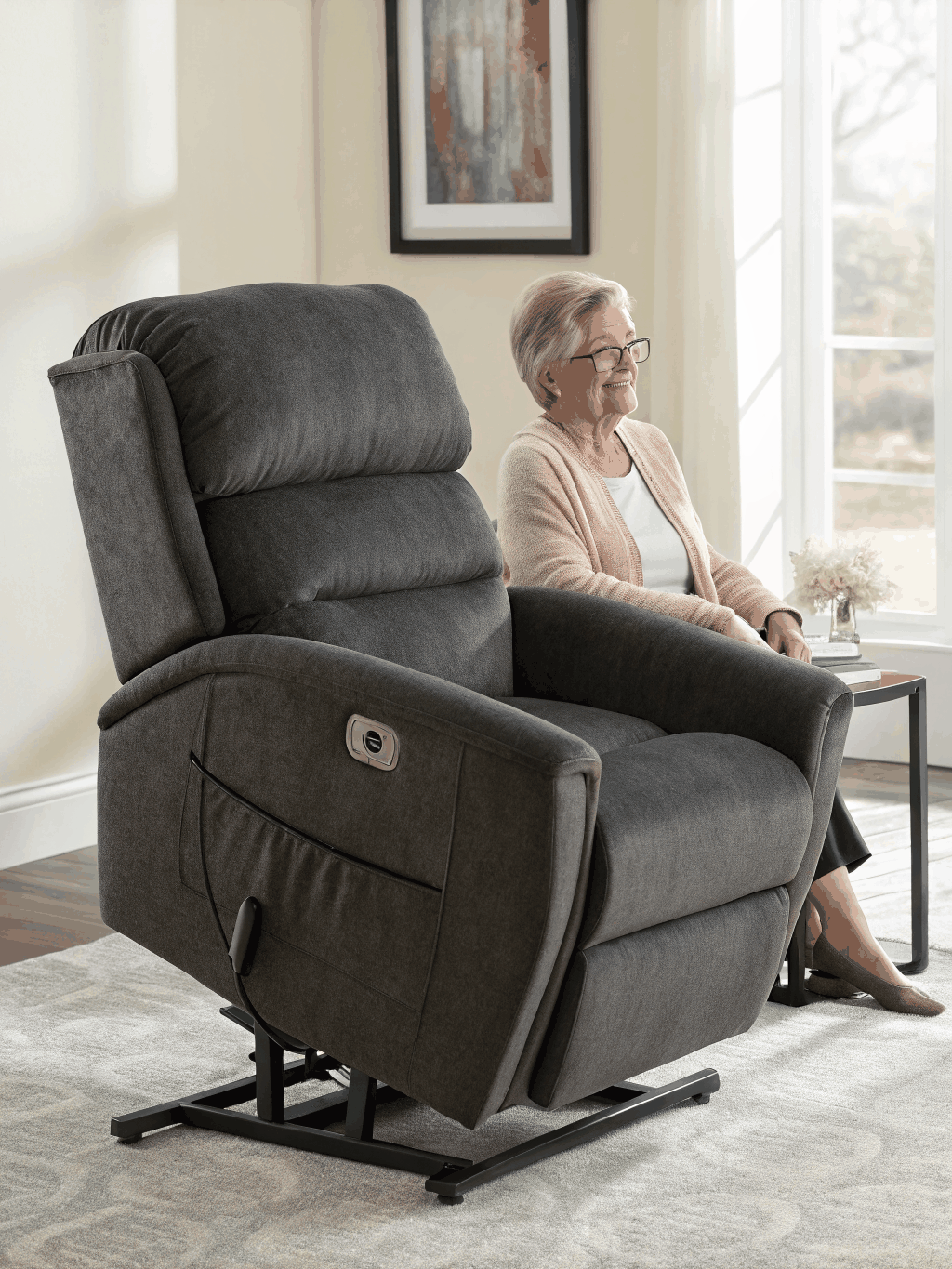
Buying Consideration
Ensure at least 18 to 24 inches of clearance between the chair back and the wall when planning room layout.
Compare the Four Main Types of Lift Chairs
Power lift recliners use motorized bases to tilt forward gently, assisting you safely into a standing position. Finding the right fit comes down to motor layout, recline depth, and frame dimensions.
Operates with a single motor where the backrest and footrest move simultaneously. Suitable for sitting, reading, and assisted standing in smaller spaces.
Key Highlights
- Footrest extends as back gently reclines
- Simpler handheld controller with fewer buttons
- Most budget-conscious mechanical design
- Requires less clearance from walls
Casual daytime sitting, TV viewing, and tighter living room footprints.
Reclines deeper than two-position models to accommodate afternoon resting, though backrest and leg rest continue to move together.
Key Highlights
- Accommodates standard seated and semi-flat resting positions
- Direct lift mechanism for steady standing transitions
- Standard dual-button hand control
- Requires moderate wall clearance
Users who want an everyday lounge chair capable of comfortable daytime resting.
Equipped with two or more separate motors, allowing independent adjustment of the backrest and the footrest to customize your angle precisely.
Key Highlights
- Backrest and footrest adjust independently
- Can recline fully horizontal like a flat mattress
- Permits feet-above-heart zero-gravity elevation
- Multi-button programmable hand remote
Individuals resting for extended durations or needing raised leg positioning.
Engineered with widened steel frames, heavy-gauge scissor mechanisms, and broader seat widths specifically rated for 500 lbs or more.
Key Highlights
- High weight capacities typically ranging 500–700+ lbs
- Reinforced heavy-gauge hardwood and steel frames
- Wider seat dimensions (24 to 30+ inches across)
- High-torque lift actuators for smooth elevation
Taller or heavier individuals needing reinforced stability and extra seat width.
Ready to explore specific lift chair models?
Review our localized selection guides and product checklists for aging safely at home.
Lift chair specifications comparison
Compare essential physical parameters, mechanical configurations, delivery logistics, and purchase protection factors before choosing a model.
Core configuration matrix
Side-by-side factor comparison across entry, dual-motor, and heavy-duty classifications.
| Factor | Standard 2-3 position | Infinite / dual-motor | Heavy-duty / bariatric |
|---|---|---|---|
| Seat dimensions | Approx. 19" – 20" W x 19" D | Approx. 20" – 22" W x 20" – 21" D | Approx. 24" – 28" W x 21" – 22" D |
| Overall chair dimensions | Approx. 32" W x 40" H x 36" D | Approx. 34" – 37" W x 42" H x 38" D | Approx. 39" – 43" W x 44" H x 40" D |
| Wall clearance | 18" – 24" clearance required | 5" – 6" (wall-hugger) or 18" – 22" | 20" – 26" clearance required |
| Controls | 2-button ergonomic wired remote | Multi-button remote with USB charging | Heavy-duty reinforced hand pendant |
| Upholstery | Standard polyester or microfiber | Performance moisture-barrier fabric | Reinforced high-durability vinyl or fabric |
| Reclining configuration | 2-position or 3-position single motor | Dual motor infinite or zero-gravity | Heavy-duty dual or triple motor recline |
| Manufacturer-stated weight capacity | Up to 325 – 350 lbs | Up to 375 – 400 lbs | 500 to 700 lbs rated |
| Assembly | Slide-on back, snap cables | Slide-on back, harness connection | Heavy frame assembly, two-person lift |
| Delivery | Standard curbside freight | Threshold or optional white-glove setup | Specialized heavy freight carrier |
| Warranty | 1-yr parts, lifetime frame structure | 3-yr to 5-yr electronics, lifetime frame | Commercial/reinforced component terms |
| Return terms | Restocking fee + buyer returns shipping | 14-30 day trial minus hygiene/freight fees | Strict restocking terms on heavy freight |
Detailed specifications breakdown
Comprehensive reference definitions for all eleven evaluation points.
Width, depth, and seat-to-floor height suited to user stature and leg length.
Varies by frame size: petite, medium, large, and extra-wide cuts.
External width, upright height, and total footprint when fully extended.
Published in product manuals; measured at widest exterior points.
Required gap between backrest and wall (zero-wall slides vs standard 18-24 inch travel).
Specified per model mechanism to prevent wall impact during full recline.
Tethered hand pendants, push-button switches, optional USB ports, and safety lockouts.
Configurations depend on single vs dual motor architectures.
Woven textiles, breathable fabrics, faux leather, and stain-resistant finishes.
Material grading and wear ratings supplied by the textile mill or builder.
Two-position, three-position, infinite-position, and zero-gravity recline travel.
Defined by motor count and scissor linkage engineering specifications.
Standard ratings (300 to 375 lbs) up to bariatric engineering (500+ lbs).
Tested under controlled static and cyclic factory load conditions.
Slide-on backrest alignment, power transformer connection, and battery backup installation.
Detailed in packaged installation guides; usually requires two people.
Threshold boxed delivery versus premier room-of-choice inside setup.
Determined by seller carrier contracts and local freight partner rules.
Tiered coverage distinguishing frame welds, lift mechanisms, motors, and fabric.
Limited manufacturer warranties typically separate mechanical from cosmetic parts.
Trial periods, factory restocking deductions, and customer-paid return freight requirements.
Governed by individual distributor policies and hygienic product conditions.
Need clarification on doorway clearance or installation logistics?
Review our comprehensive home accessibility guides or connect directly through our contact page to learn how room measurements align with specific builder models.
Measure your room and fit before you buy
Record these physical clearances before ordering stair lifts, ramps, or walk-in tubs. A tape measure and ten minutes can prevent return shipping fees and installation delays.
Your Checklist Progress
0 of 12 specifications checked
Standard stair lifts typically require a minimum of 29 to 32 inches of clear width.
Measure along the incline from the bottom step nosing to the top landing edge.
Ensure at least 24 inches of clear floor area so entry doors and hallways are not obstructed.
Check for a standard 110V grounded outlet within 6 to 10 feet of either stair landing.
Measure straight across the widest point while seated to ensure armrest clearance.
Standard equipment capacities range between 300 to 350 lbs; bariatric units offer 450+ lbs.
Helps verify knee clearance against walls or railings during the transit path.
Ensures feet can comfortably rest on the footrest and make safe transfers at both landings.
Ensure the crated unit can pass through interior hallways, turn corners, and clear doorways.
Most traditional alcoves are 60 inches long by 30 or 32 inches deep.
Walk-in tubs generally require a 50-gallon or fast-recovery 60+ gallon tank for adequate fill.
Confirm whether you need a left-hand or right-hand door and drain configuration.
Ready to explore verified equipment suited for your verified spaces?
Delivery and installation guide for home equipment
Avoid common installation delays and return fees. Prepare your home layout, electrical access, and entryway paths before placing an order.
Mobility equipment ships via standard freight or specialized white-glove transport.
- Curbside freight delivery typically leaves heavy wooden crates at the end of the driveway.
- Threshold delivery brings crates past the front door or garage but does not unbox them.
- White-glove carriers unpack, stage items in the designated room, and remove all packing refuse.
Factory warranty and mechanical safety often depend on who tightens the final bolts.
- Stair lift rails and motor housings require certified technicians to maintain warranty validity.
- Modular aluminum ramps can often be assembled with basic tools if local code permits.
- Walk-in tub installations require licensed plumbing and waterproofing inspections.
Evaluate daily movement patterns and transfer clearance before anchoring any hardware.
- Allow at least 36 to 48 inches of unobstructed clearance at landing zones for wheelchair transfers.
- Verify structural stud integrity before installing wall brackets, handrails, or vertical platform posts.
- Ensure bottom stair lift footrests do not impede main corridor hallways or exit paths.
Motorized mobility systems require consistent power without trailing extension cords.
- Stair lift battery docks need a dedicated standard 110V/120V outlet within 6 to 10 feet of the rail end.
- Walk-in bathtub pumps and inline heaters require dedicated 15-amp to 20-amp GFCI circuits.
- Never run charging cords beneath carpet runners or through high-traffic doorways.
Measure opening widths, door swing angles, and sill thresholds along the transit path.
- Measure the narrowest entry point between doorstops; 32 inches is the baseline, 36 inches is preferred.
- Account for interior door swing radiuses that may restrict wheelchair or gurney turning.
- Check exterior threshold transitions—lip heights exceeding 0.5 inches require bevel transition strips.
Need help assessing your layout?
Review manufacturer technical specifications and local code requirements in our comprehensive buying guides before ordering.
Questions to Ask Before You Buy
Protect your budget and ensure safety before placing an order. Ask retailers and manufacturers these critical questions about fit, weight capacity, warranties, installation, and returns.
Questions Checked
Mark off questions during your consultations
Dimensions & Fit
Ask during initial sales and technical consultations
Weight Capacity & User Needs
Ask during initial sales and technical consultations
Warranty & Service Support
Ask during initial sales and technical consultations
Delivery & Installation
Ask during initial sales and technical consultations
Returns, Restocking & Trials
Ask during initial sales and technical consultations
Always get written itemized estimates
Never sign or pay a deposit until equipment specifications, labor, shipping charges, and cancellation terms are clearly detailed in writing.
Vive Health
Vive Health offers direct-to-consumer power lift recliners engineered for independent home living, featuring multi-position recline options, powered transition assistance, and modern upholstery selections.
Affiliate link — verify current specifications, availability, pricing, delivery, warranty, and return terms directly with Vive Health.
Additional providers under review
Frequently asked questions about lift chairs
Objective specifications, sizing factors, delivery protocols, and warranty terms compiled from current manufacturer manuals.